

What a beetle and a brick wall taught me about the part I kept skipping
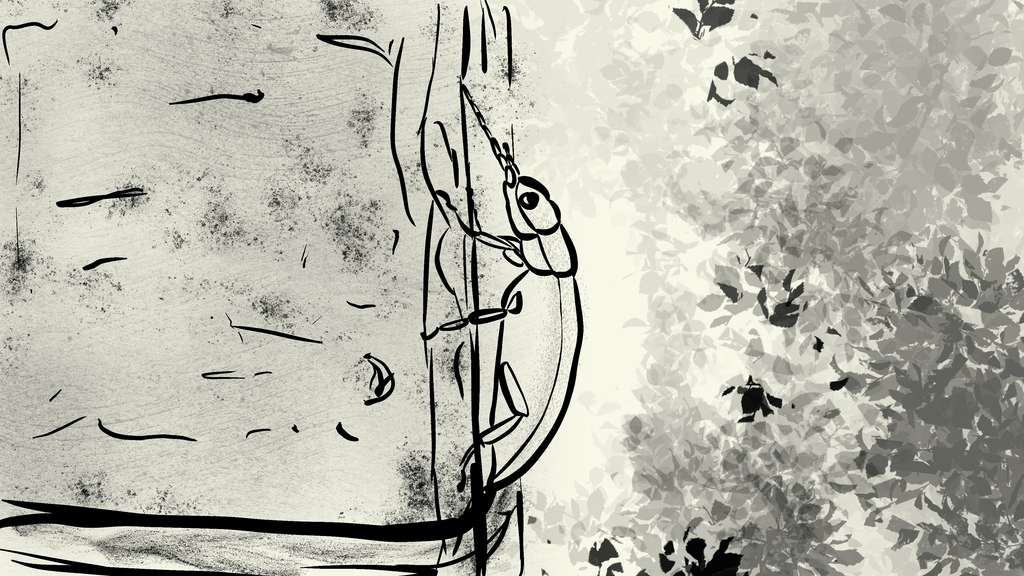
It was a common beetle. The thin, tiny kind. Black. I see them when I work in my garden. This one was making its way up the side of my house, along the edge of my front stoop. I was sat there, enjoying the afternoon sun and the cool breeze of an autumn that finally found its way to my part of the world.
I became engrossed as I watched the beetle walking up a bit of brick with plenty of tiny pits and grooves for its wee little hooky paws to latch onto. About ten inches or so above the cemented walkway, just above the grout line, the beetle reached a smooth brick. The face had very few holes and when the beetle tried moving up, its front paws scrambled about, reaching for a hookhold and finding very little to work with. When it found one and began to pull, it fell from the wall and pipped on the cement. Undaunted, he (she?) reoriented himself, turned back towards the wall, and started back up.
I’m not sure how beetles navigate. I presume it’s with their antennae, as his were tapping about the way blind people do with their cane. Straight up he went, in pretty much the same path. I’m not saying it was the exact path, but it was close because I could see he was headed for the same smooth-faced brick. Once again, he reached the spot and PIP!, he was back on the ground.
I glanced up the wall, wondering what was so important that this little guy would persist. Just the naked brick wall to the overhang. Regardless, Beetlebro (that’s what I started calling him) was back at it. Tap tap tapping his way steadily up the same general path and again, he fell.
As you do, I got invested in this little guy’s process, so much so, I began to coach him. “Beetlebro, move to the side.” He wasn’t listening, or chose to ignore me, because he was back at it, same path, same direction. “I love your pluck,” I told him, knowing he was about to fail again.
This time, though, I noticed his reach moved to the right a bit, massive by beetle standards, about two inches from our perspective. There seemed a small but navigable path for him, but he was going to have to…PIP. I was tempted to pick him up and place him past the brick but that didn’t seem right. And he certainly didn’t need the panic of some gigantic something messing with his journey, even if it would help, which, from the beetle’s perspective, would be anything but.
So I watched as, again, Beetlebro made his way upwards, only this time, he shifted left at the brick. “NO!” I hissed. “Wrong way.” PIP. I shook my head. “You’re getting desperate. Go to the right, it’s right there. You almost had it the time before.” I glanced around to make sure nobody was outside that could hear me talking to a beetle. All clear.
Beetlebro had reached the brick and was once again moving to the right, toward the tiny path. I traced the way up and if he could get past the smooth brick, it was a brick-walk the rest of the way. I watched as his feet and antennae tapped and clasped, reaching, clawing, struggling with the problem. I realised I was holding my breath. “You got this bro.”
And just like that, Beetlebro was ambling up the wall.
I don’t know why Beetlebro wanted up the wall or where he was going. He overcame. No shortcut. No optimization. He simply faced the problem and went at it. Sure, he could endure falling down repeatedly and getting back at it. He doesn’t have a mortgage, or bills to pay. If beetles have insurance, it clearly wasn’t needed for what he was doing.
The goal determined a way. And the work was the overcoming. Goal and process reduced to its simplest form. Beetlebro kept at it until he overcame.
And the interesting part of this for me is that the obstacle was not the destination. It was something he encountered along the journey. And it set him back multiple times. Not to the beginning, because I don’t know from where he started. Did he crawl up from under the soil in my garden and begin his journey at the base of the wall? Or did he start from the other side of the neighborhood? Where Beetlebro was in his journey didn’t matter to him. The setback didn’t stop him.
When I face problems, I want solutions. And, depending on my problem, I can probably find any number of solutions, from a quick, 10-page PDF to full blown video courses with deep analyses and step-by-step processes.
But there’s a catch: solutions point the way. We still have to do the work. Even when these solutions give us step by step direction, materials and templates, and all the tools necessary, we have to roll up our sleeves and actually climb the wall. If we follow the steps, we might avoid falling off the wall at the same place. Because the solution helps us find the way. But the work is ours.
My biggest problem with solutions is that I’d read them, learn the processes, and then…do nothing. I would look up at the wall, map in hand, tool belt strapped on, and determine that it was too much. Or that it couldn’t possibly work. Or decide there has to be a better, shorter way than climbing up that damned wall. What if I fall? What if I’m not enough? What if it doesn’t work for me?
So it became easier for me to read about the solution and believe that it could be done. And imagine what it would be like having accomplished the climbing of the wall, reaching the goal that I could imagine but isn’t obvious glancing up the wall. And let the feeling of accomplishment from imagining it be enough. Without actually doing the work. Where the impossible seems possible because, hey, look, I have the tools and the path from a guru.
Solutions are helpful when you use them. So is bumping about until you find your way. Either way, the solution is in the doing.